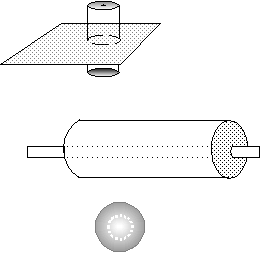
 Gauss' law is a
much simpler way of finding E than
Coulomb's law in situations with a large amount of symmetry. Typically,
the gaussian surface should have the same symmetry as the problem.
Gauss' law is a
much simpler way of finding E than
Coulomb's law in situations with a large amount of symmetry. Typically,
the gaussian surface should have the same symmetry as the problem.
Gauss' law is a
much simpler way of finding E than
Coulomb's law in situations with a large amount of symmetry. Typically,
the gaussian surface should have the same symmetry as the problem.
When Gauss' law is used to find E at a
point:
The surface should contain
the pont in question.
The field should be constant
across the surface. (Where the surface is discontinuous, it should be 'piecewise
constant' )
The surface should be
chosen so that the field is always perpendicular to the surface.
E inside (in the interior of) a conductor
is zero, so a gaussian surface that is contained in the conducting material
surrounds a net charge of zero. This allows you to find the charge induced
on conducting surfaces that enclose charged particles.
Things you should be able
to do for the test:
1. Know how to charge objects by conduction
and induction. Know the sign of the charge generated by rubbing various
materials.
2. Use Coulomb's law to find F
and E, (magnitude and direction)
due to a distribution of point charges. (Or conversely, find the magnitude
of point charges from F and
E.)
3. Use Coulomb's law to find F
and E, (magnitude and direction)
due to a continuous distribution of charge.
4. Be able to sketch electric field lines,
and interpret sketches of field line.
5. Be able to calculate electric flux through
a surface due to an E field.
6. Be able to use Gauss' law to find flux.
7. Be able to use Gauss' law to find E.